The best lava caves in Iceland to visit are Víðgelmir in West Iceland, Raufarhólshellir near Reykjavík and Vatnshellir on Snæfellsnes. All three are open all year on guided tours with helmets and lights provided. For something different, Þríhnúkagígur lets you ride a lift down into an empty magma chamber. Iceland is known for ice caves, but it has far more lava caves, also called lava tunnels or lava tubes, and most of them can be visited whatever the season or the weather.
The best lava caves in Iceland at a glance
There are more caves than fit into one trip, so here is the short version. Pick by where you are going and how much scrambling you want.
- Víðgelmir (West Iceland): the largest, on a walkway with lights. Easy.
- Raufarhólshellir (40 to 45 minutes from central Reykjavík): the closest big lava tunnel. Easy.
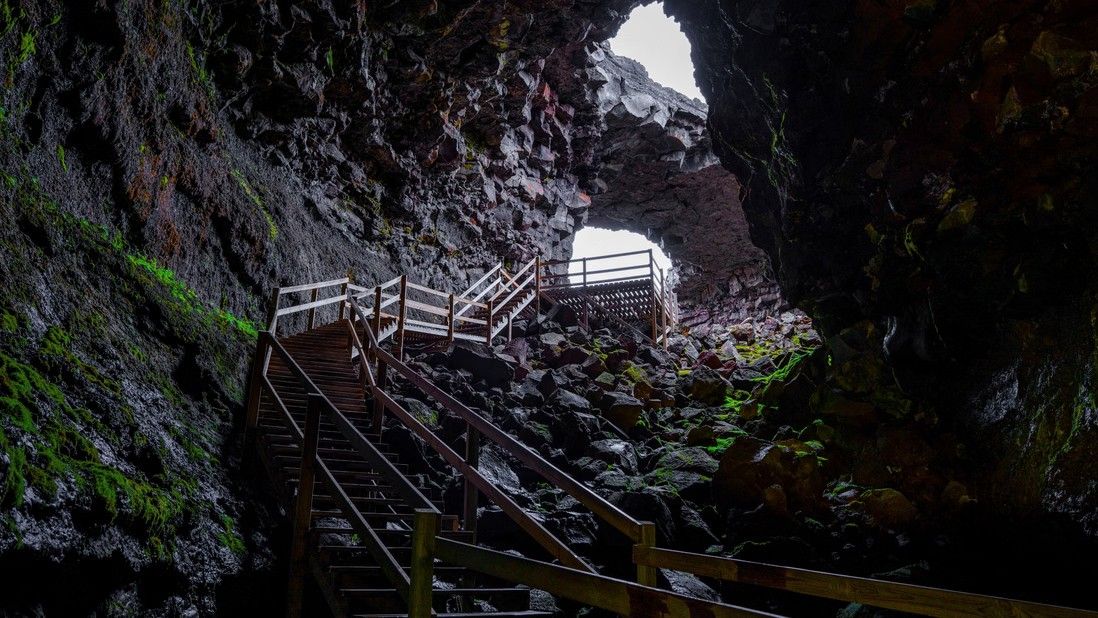
- Vatnshellir (Snæfellsnes): a spiral staircase down into a dark cave lit by torches. Easy to moderate.
- Þríhnúkagígur (near Reykjavík): a lift into an empty magma chamber, in the warmer months only.
- Leiðarendi (near Reykjavík): a real caving trip with low sections. Moderate.
- Lofthellir (Mývatn): ice sculptures inside a lava tube, reached by a crawl. Demanding.
- Grjótagjá (Mývatn): a small cave with a hot spring, to look at for a few minutes.
- Búri, Gjábakkahellir, Surtshellir and Maríuhellar: wilder or smaller caves for people who want more.
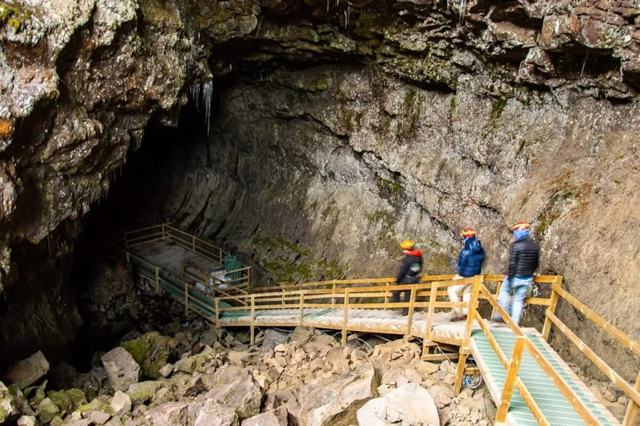
How lava caves form
Iceland sits on a volcanic hot spot on the Mid-Atlantic Ridge. That gives it volcanoes, geothermal areas with geysers and hot springs, and lava fields full of caves. Some caves have ice in them all year, and one or two even hold hot water.
Most lava caves in Iceland are lava tubes. When a lava flow runs downhill, its surface cools and hardens into a crust while hot lava keeps flowing underneath. When the eruption stops and the molten lava drains out, a hollow tunnel is left behind.
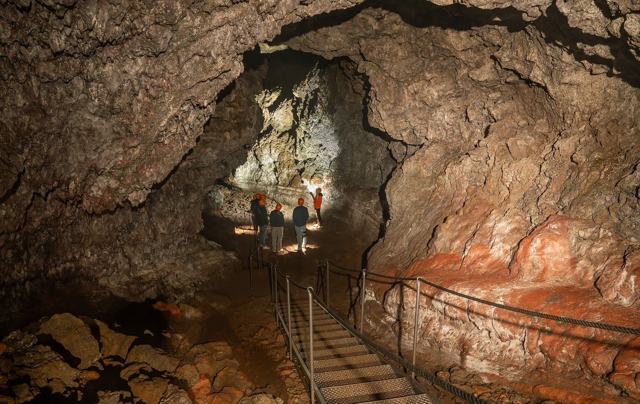
Inside you can see the story of that flow: ledges where the lava level dropped, dripping lava stalactites, smooth walls and colours from iron and other minerals. In winter many caves also fill with ice formations near the entrance.
A few caves formed in other ways. Þríhnúkagígur is a drained magma chamber, Grjótagjá is a crack in the lava that filled with hot groundwater, and the hollows at Hljóðaklettar are the insides of old craters, opened up by a glacial river.
In the past, Icelanders used caves as shelter from bad weather, as hiding places and as pens for sheep. Some farm caves are still used today. For the bigger picture, see our guide to volcanoes in Iceland.
Víðgelmir: the largest lava cave
Víðgelmir is Iceland's largest lava tube and one of the largest in the world by volume. It is about 1,585 metres long, and at its biggest the passage is around 16.5 metres wide and 15.8 metres high. It sits in the Hallmundarhraun lava field in Borgarfjörður, West Iceland, which formed around the year 900.
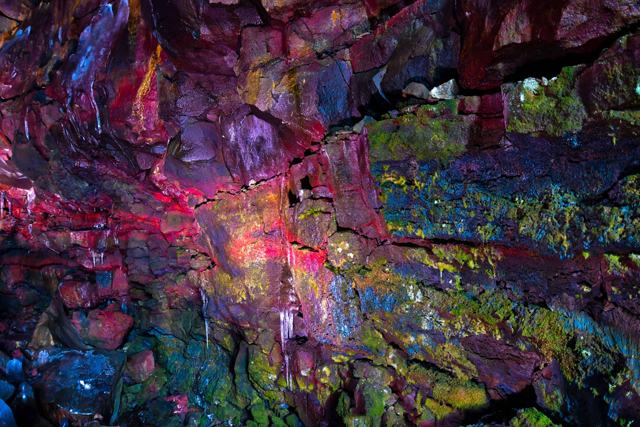
The lava field is from the time of the first settlers, and people used the cave early on. Remains of human habitation, probably from the Viking Age, were found inside and are now kept in the National Museum of Iceland. On the tour you see walls coloured by minerals, lava stalactites and stalagmites, and lava that froze as it flowed. In winter there are ice formations near the entrance.
An iron gate protects the fragile formations and the floor is rough, so you can only go in with a guide. Tours are about 1.5 hours, run all year and have walkways through much of the cave. It is roughly a 2-hour drive from Reykjavík, and a normal car is fine.
Combine it with Hraunfossar, Barnafossar, Húsafell and Deildartunguhver for a full day in the west. Our Silver Circle & Víðgelmir lava cave tour does exactly that from Reykjavík, all year. See also our West Iceland tours.
Raufarhólshellir: the lava tunnel near Reykjavík
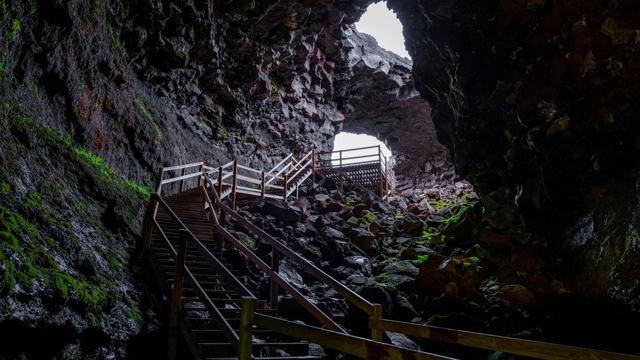
Raufarhólshellir is the easiest lava cave to visit from Reykjavík, 40 to 45 minutes' drive from the city centre. It is the fourth-longest lava cave in Iceland at around 1,360 metres, at least 10 metres high and up to 30 metres wide, so there is no crawling. It formed a little over 5,000 years ago in the Leitahraun eruption.
The cave was open to anyone until 2016, when visitors had damaged almost all of its fragile lava straws. It reopened in 2017 with walkways and lighting, and is now visited on guided tours only. The standard tour is about 1 hour on site, or around 3 hours with transfer from Reykjavík. Sunlight falling through holes in the roof and the colours on the walls make it a good cave for photos. It was used as a filming location for the film Noah.
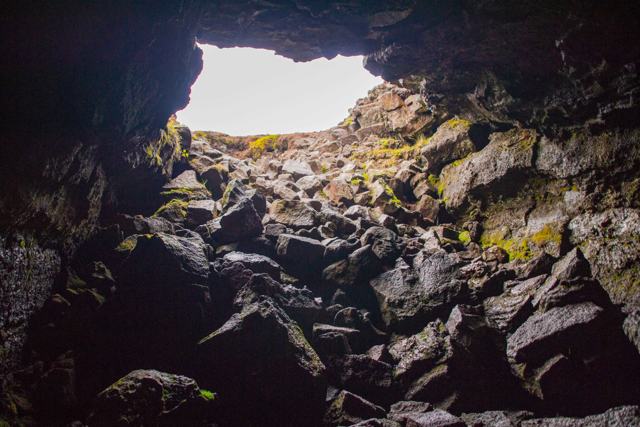
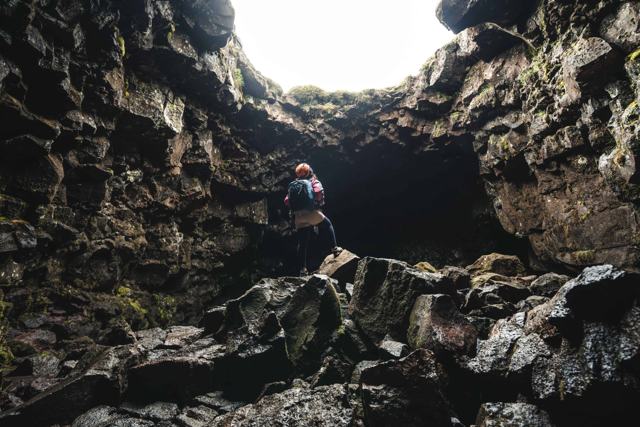
The roof has fallen in at a few places near the entrance. Daylight comes down through the holes, and in winter so does snow, which freezes into ice sculptures on the cave floor that change through the season. Deeper in, the rock shows reds, yellows, greens and purples from minerals and heat.
See our Raufarhólshellir lava tunnel tours. Some tours combine the cave with the Golden Circle, such as our Golden Circle & Raufarhólshellir Lava Tunnel day tour.
Vatnshellir: 8,000 years old on Snæfellsnes
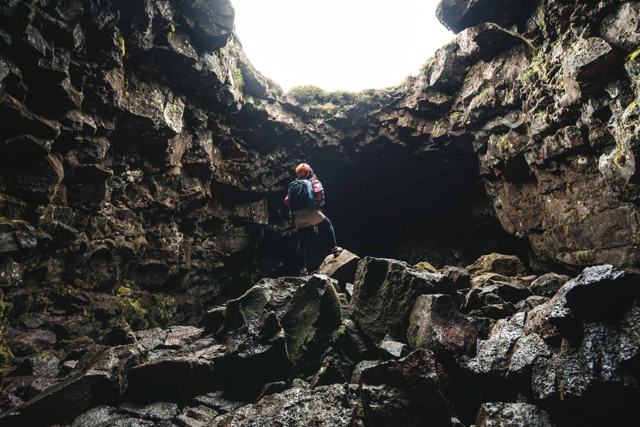
Vatnshellir is in Snæfellsjökull National Park, about 10 minutes' drive from Hellnar. It lies in the Purkhólahraun lava field, which came from the Purkhólar craters, and the name means 'water cave'. The cave is around 8,000 years old and about 200 metres long. A spiral staircase takes you down to about 35 metres below the surface, into two levels of tunnel.
There is no permanent lighting, so you explore by headlamp. Tours are guided only, run all year, and the minimum age is 5. From the foot of the stairs you walk through the tunnel on fairly level ground, past lava that set mid-flow and walls in rusty reds and yellows. Expect about 6°C inside, damp floors and uneven ground. It fits well into a day on the peninsula with Arnarstapi and Djúpalónssandur. See our Snæfellsnes tours.
Þríhnúkagígur: inside a volcano
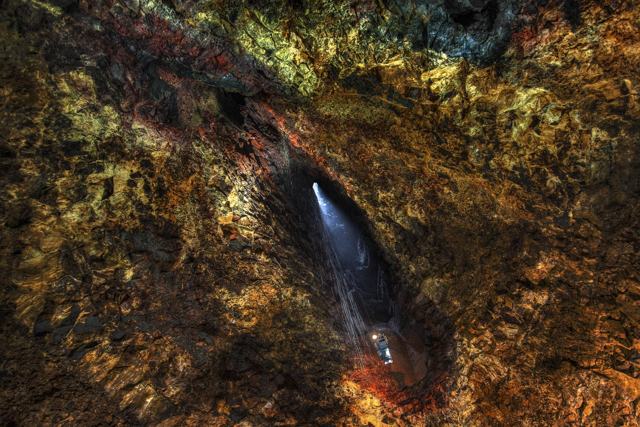
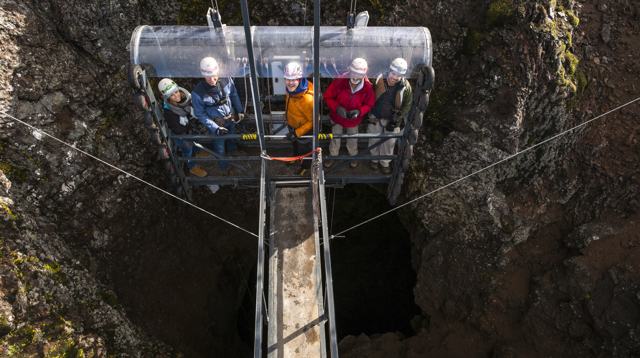
Þríhnúkagígur is not a lava tube but a dormant volcano whose magma chamber emptied instead of filling with solid rock. It has not erupted for about 4,000 years and sits in the Bláfjöll (Blue Mountains) area, south-east of Reykjavík. The crater is about 213 metres deep in total. The open lift takes you about 120 metres down to the floor of the main chamber, which covers around 3,270 square metres; the deepest part below that is a narrow shaft visitors do not enter.
Two things make it special: the size and the colours. The floor of the chamber is about as big as three basketball courts side by side, and the Statue of Liberty would fit inside it with room to spare. The walls are streaked with red, yellow, green, brown and near-black. If you want to see the inside of a volcano and not another tunnel, this is the one.
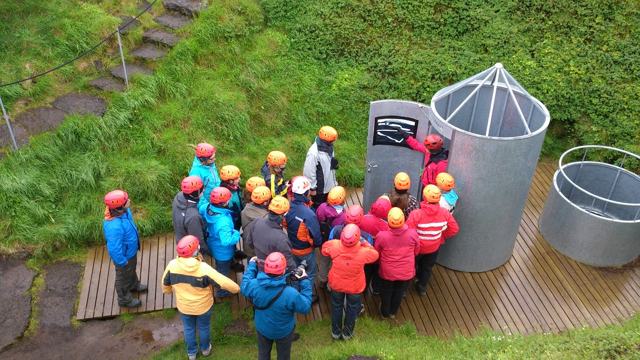
You wear a helmet and harness and ride an open lift down into the chamber, then spend about 30 to 45 minutes looking at the red, yellow and black walls. It is about 35 minutes from Reykjavík, followed by a walk across the lava to the crater. Tours run in the warmer months only, so check dates before planning around it. Our Inside the Volcano tour runs from May to October, with hotel pick-up in Reykjavík available for an extra fee. See also our volcano tours.
Leiðarendi: a caving adventure near Reykjavík
Leiðarendi is a lava tube in the Tvíbollahraun lava field near Bláfjöll, about 30 minutes' drive from Reykjavík. It is about 900 metres long and is one of the best examples of an Icelandic lava tube. It is a proper caving trip rather than a walkway tour. There is some scrambling and a few low sections where you crouch or crawl. You see lava stalactites and stalagmites, polished walls, thin lava flakes that frost has loosened from the roof and, in winter, ice formations.
The cave has no lighting or paths and the entrance can be covered by snow in winter. People used to explore it on their own with boots, a helmet and a headlamp, but the formations are fragile and visits are now meant to be guided. Guides provide helmets, lights and gloves, and small-group tours often include pick-up in Reykjavík. See our lava cave tours.
Lofthellir: the lava cave with ice sculptures
Lofthellir is a lava tube near Mývatn in North Iceland, about 3,500 years old and around 370 metres long. It holds the largest natural ice sculptures found in any Icelandic lava cave: columns, domes and frozen falls that stay all year, because the cave sits at about 0°C.
Getting in is part of the trip. Tours drive about 45 minutes from Mývatn on a rough track, then walk 20 to 30 minutes across a lava field. The entrance is narrow, and you crawl on your stomach for a metre or two to get through. Inside, the floor is ice, and you use a rope on the slippery parts. The whole trip takes 4 to 6 hours, with about an hour in the cave.
It is not a cave for small children, or for anyone with bad knees or hips or a fear of tight spaces. You can only go with a guide, who provides helmets, lights and the rest of the equipment. If you want adventure, it is one of the best cave trips in the country.

Grjótagjá: the cave with a hot spring
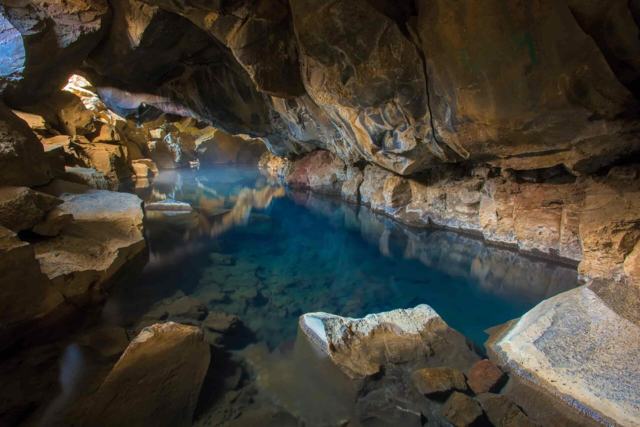
Grjótagjá near Mývatn is a small lava cave in a fissure, with clear blue geothermal water inside. It is on private land belonging to a local farm, but the family lets visitors in free of charge. The entrance is a narrow gap in the rock and only a little daylight gets in. It takes a few minutes from the parking area.
People once bathed here, but during the Krafla eruptions of 1975–1984 the water rose above 50°C. It has cooled a little since, but the temperature is unpredictable, so please do not bathe. The cave is worth the stop anyway. It became famous as a filming location in the third season of Game of Thrones, in the scene with Jon Snow and Ygritte. See our Game of Thrones locations guide and North Iceland tours.
More caves and cave-like sights
- Surtshellir: a long lava tube in Hallmundarhraun, the same lava field as Víðgelmir. You can walk into parts of it yourself, but the floor is rough, so bring a good torch and a helmet.
- Maríuhellar: small lava caves in Heiðmörk on the edge of Reykjavík, easy to reach for a short visit.
- Búri: a lava tube in the Leitahraun lava field in the south-west, about 1 kilometre long and roughly 10 metres high and wide at its biggest. It ends in a 17-metre vertical pit made by a lava fall, and ice sculptures often stand at the entrance in winter. It is a hard trip, with climbing and crawling over loose rock. The landowners closed the cave in 2014 to protect it, so it can only be entered on an authorised guided trip.
- Gjábakkahellir: a lava tube beside Þingvellir National Park, also known as Helguhellir or Stelpuhellir ('girls' cave'). It is open at both ends, so you can go in one way and out the other, with some crawling and scrambling over boulders. Look for the pointed lava stalactites on the roof, which look like rows of shark teeth. It can be added to a Golden Circle day, but bring a helmet and good lights, or go with a guide.
- Hljóðaklettar: not a true lava cave but twisted basalt columns and hollows in Jökulsárgljúfur canyon, beside the glacial river Jökulsá á Fjöllum. The best-known hollow is Kirkjan, 'the Church', a cave shaped like a vaulted arch. The acoustics are strange and strong, and the echoes gave the place its name, which means 'echo rocks'.
- Caves of Hella: man-made caves dug into soft rock in South Iceland, visited on guided tours. They are not lava caves, but they are a good addition to a South Coast trip. The Caves of Hella private tour adds locally made whisky, beer and food tastings.
Tips for visiting lava caves
A little preparation makes any cave visit easier. Walking boots, a warm jacket and waterproof clothing cover most of it.
- Go with a guide. Most of the best caves are protected and open only on guided tours, and guides provide helmets and lights.
- Wear sturdy, closed walking shoes or boots. Lava floors are sharp and uneven.
- Dress warmly. Caves stay close to freezing or a few degrees above all year, and water often drips from the roof. See our Iceland packing list.
- Bring thin gloves you do not mind getting dirty. You will put your hands on cold, rough rock.
- Do not touch or break formations. Lava straws and stalactites never grow back.
- Caves are a good bad-weather option, because the inside is the same whether it rains or shines.
- Check minimum ages. Walkway caves suit families, while crawling tours are for older children and adults. See our family-friendly tours.
- On crawling tours such as Leiðarendi and Lofthellir, wear old or waterproof trousers. If tight spaces worry you, choose Víðgelmir or Raufarhólshellir, which are wide and high.
Tours to book
If you want the caves booked before you arrive, these are the ones we would start with.
- Silver Circle & Víðgelmir lava cave: Iceland's largest lava cave plus Deildartunguhver, Hraunfossar and Barnafoss in one day from Reykjavík.
- Golden Circle & Raufarhólshellir Lava Tunnel: the easiest lava tunnel near Reykjavík, added to a Golden Circle day.
- Inside the Volcano: the lift down into Þríhnúkagígur's magma chamber, in the warmer months.
Questions people ask
What is the best lava cave to visit in Iceland?
For size, Víðgelmir in West Iceland. For convenience, Raufarhólshellir, 40 to 45 minutes from central Reykjavík. For a smaller, darker cave on a scenic day trip, Vatnshellir on Snæfellsnes.
Can you visit lava caves in Iceland without a guide?
The main show caves, including Víðgelmir, Raufarhólshellir and Vatnshellir, are guided only. A few smaller caves are open, but you need a helmet, several lights and good boots, and a guide is safer.
Are lava cave tours open in winter?
Yes. Víðgelmir, Raufarhólshellir and Vatnshellir run tours all year, and winter often adds ice formations. Þríhnúkagígur is seasonal.
What should I wear in a lava cave?
Warm layers, a waterproof jacket, gloves and sturdy walking shoes or boots. Helmets and lights are provided on tours.
Is there a lava cave with a hot spring in Iceland?
Yes. Grjótagjá near Mývatn is a small lava cave with a geothermal pool inside. You can look, but bathing is not allowed, because the water temperature is too high and changes without warning.
Which lava cave in Iceland has ice sculptures?
Lofthellir near Mývatn has the largest ice formations and keeps them all year. Raufarhólshellir, Víðgelmir and Leiðarendi have ice near the entrance in winter.