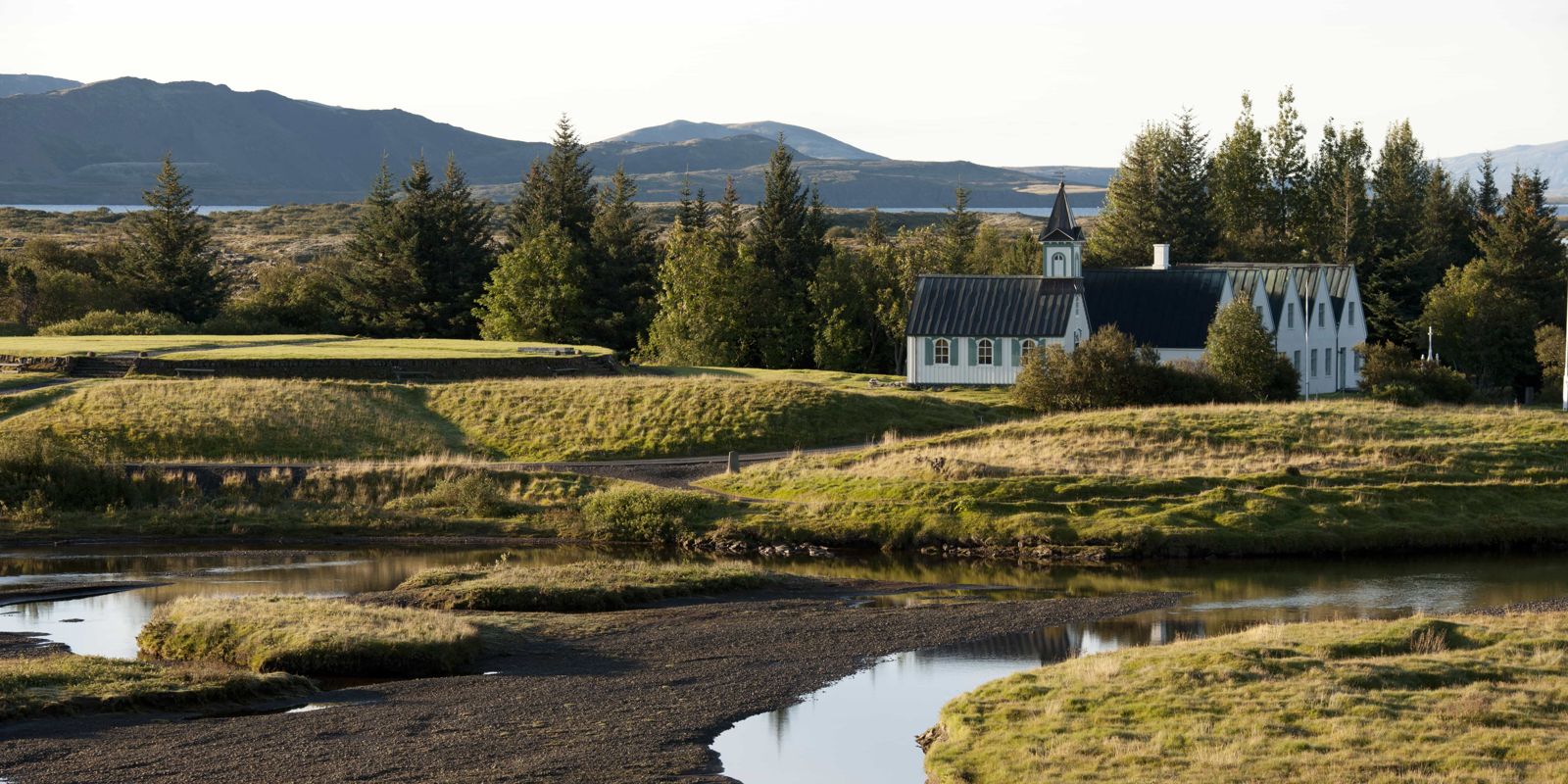
Iceland was settled by Norse Vikings in the late 800s, and it is one of the best places in the world to learn how they lived. You can stand on the spot where their parliament met in 930, see a wall built around 871 under the streets of Reykjavík, and walk into rebuilt longhouses. This guide covers the history, the old gods and the Viking sites worth your time.
Who were the Vikings? An introduction to the settlement of Iceland
The Vikings, or Norse, came from Scandinavia. Between the 8th and 11th centuries they raided, traded and settled across the North Atlantic and beyond. Elsewhere they were feared as raiders who took what they wanted from the villages they attacked. Iceland was different. There was no one to raid, so the people who sailed here in open ships with their families, slaves and livestock came as farmers and fishers. Icelanders call the settlement landnám, which means land-taking.
Most settlers sailed from western Norway, but many came by way of the Norse colonies in Scotland and Ireland. Genetic studies show that about 75% of Icelanders' male-line ancestry is Scandinavian, while about 62% of their female-line ancestry comes from Scotland and Ireland. Many of those Gaelic women and men probably arrived as slaves.
You will notice the heritage as soon as you arrive. Viking figures stand outside shops and hotels, souvenir shops are full of drinking horns, Thor's hammers and Norse god figures, and you can dress up, eat and even sleep Viking-style if you want to. Some of it is tongue-in-cheek, but behind it is a real and well-documented history.
Were there people in Iceland before the Vikings?
Possibly. The medieval Íslendingabók (Book of Icelanders), written by Ari the Wise in the 12th century, says Irish monks called papar were living in Iceland when the Norse arrived, and that they left rather than live among pagans. Others have guessed that the harsh land and climate drove them away. Some carved crosses in caves in the south may be linked to them, but the evidence is thin and historians still debate it. Apart from Ari's short mention, there is no firm proof that an Irish community ever took root here.
The first Norse explorers
The sagas and Landnámabók (Book of Settlements) name several men who found Iceland before anyone stayed. These books were written two or three centuries after the events, so treat the details as tradition rather than hard fact.
- Naddoddur was blown off course on the way to the Faroe Islands. By the usual account he was the first Norseman to set foot on Icelandic soil. He stayed only briefly. Snow fell on the mountains as he left, so he called the land Snæland, land of snow.
- Garðar Svavarsson, a Swede, came around 860. A storm drove his ship to the east coast. He followed the coast all the way round and so proved that the land was an island. He was the first to spend a winter here, at what is now Húsavík in the north. The name means bay of houses, after the houses he built. He left the next summer and never came back. He named it Garðarshólmur. One of his crew, Náttfari, stayed behind with two slaves and lived at Náttfaravík across the bay, but he is not counted as the first settler.
- Flóki Vilgerðarson, known as Raven-Flóki, set out on purpose to find the new land and took three ravens to guide him. Past the Faroe Islands he released them. The first flew back the way they had come, the second circled and returned to the ship, and the third flew straight ahead. Flóki followed it and reached land. He wintered in Vatnsfjörður in the Westfjords, lost his livestock over a hard winter, and after seeing a fjord full of drift ice named the country Ísland. He stayed more than a year and went home to Norway unimpressed, but he later returned and settled for good.
Ingólfur Arnarson and the founding of Reykjavík
Ingólfur Arnarson is remembered as Iceland's first permanent settler. He and his foster brother Hjörleifur had to leave Norway after a blood feud. They first sailed out to look at the new land, liked what they saw, and came back a few years later with their households to stay. Tradition dates his arrival to 874. As he neared land he threw his high-seat pillars (carved posts from his hall) overboard and vowed to live wherever they came ashore. His slaves found them some years later in a smoky bay, and he built his farm there. He called it Reykjavík, smoky bay, after the steam from the hot springs. Tradition says the pillars came ashore by Arnarhóll, the grassy hill in the city centre where a statue of Ingólfur now stands.
Hjörleifur settled further east on the south coast, at Hjörleifshöfði, but was killed by his own Irish slaves. The slaves Ingólfur had sent to look for the pillars found the body instead. Ingólfur buried his foster brother according to Norse custom, then chased the killers to islands off the south coast, which is how the Westman Islands (islands of the westmen, or Irish) got their name.
Archaeology backs up the broad picture. Under central Reykjavík, a wall fragment lies just above a layer of volcanic ash dated to 871, give or take two years. That ash layer lets archaeologists date early Norse sites all over the country.
The final stages of settlement and the Alþingi
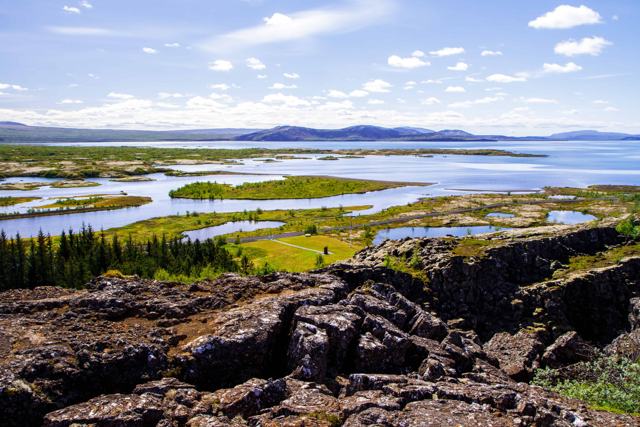
The settlers were quick. Ari the Wise writes that Iceland was fully settled in sixty years, and by around 930 most of the usable land had been claimed. People kept arriving through the 10th century, but they had to buy land or take what was left. Estimates of how many people came vary widely, from a few thousand to over 20,000. In 930 the chieftains founded the Alþingi, a general assembly that met every summer at Þingvellir. There was no parliament building. The assembly met in the open air, and people lived in temporary booths of turf and cloth for the two weeks it lasted. It made laws and settled disputes, and it is often called one of the oldest parliaments in the world.
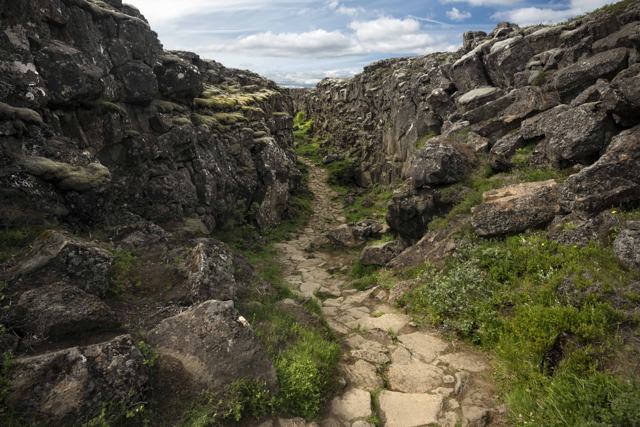
Þingvellir is now a national park and UNESCO World Heritage Site, and it is on every Golden Circle tour. Walk through Almannagjá gorge to the Law Rock area, where the lawspeaker once recited the law from memory. It was also at Þingvellir, around the year 1000, that Iceland agreed to become Christian. For more time at Þingvellir, our Golden Circle private tour lets you go at your own pace with a local guide.

Norse gods, the Vikings and Iceland
The first settlers were mostly pagan, and much of what we know about the Norse gods was written down in Iceland, in the Eddas of the 13th century. The gods fell into two families: the Æsir, linked with war, rule and wisdom, and the Vanir, linked with fertility, the land and good harvests. The gods lived in Asgard, and humans lived in Midgard.
In the myths there are nine worlds, held together by the world tree Yggdrasil. Besides Asgard and Midgard they include Vanaheim, home of the Vanir, Jötunheim, the land of the giants, the worlds of the elves and the dwarves, icy Niflheim, fiery Muspelheim and Hel, the realm of the dead. Warriors who died bravely in battle were carried by the Valkyries to Valhalla, Odin's hall in Asgard.
Iceland became Christian around the year 1000 and most Icelanders today belong to the Lutheran church. The old faith has not vanished, though. Ásatrúarfélagið, a modern pagan association, has been a recognised religious organisation since 1973.
If you know Thor, Loki and Odin from films and comics, the originals are rougher and stranger. These are the main figures:
- Odin, the Allfather, was king of the gods and god of wisdom, poetry, war and death. He stands for sacrifice and a constant thirst for knowledge: he gave up an eye for a drink from the well of wisdom. Wednesday is named after him. Fallen warriors joined him in Valhalla.
- Thor, Odin's son, was the thunder god who defended gods and people with his hammer Mjölnir and a belt, Megingjörð, that doubled his strength. Thursday is Thor's day. He was hugely popular with ordinary farmers, and the valley of Þórsmörk (Thor's forest) is named after him.
- Frigg, Odin's wife, was queen of the gods and linked with marriage, motherhood and foresight. She shared Odin's high seat and much of his wisdom.
- Baldur, son of Odin and Frigg, was the gentle, much-loved god and owner of the great ship Hringhorni. When he began to dream of his own death, Frigg made everything swear not to harm him, except the mistletoe, which seemed too small to matter. The gods then made a game of throwing things at him. Loki, disguised as an old woman, found out about the mistletoe, and Baldur was killed by a mistletoe dart thrown by his blind brother Höður.
- Loki was the shape-shifting trickster. He was the son of giants but lived among the gods, sometimes helpful, often dangerous, and usually helpful only after he had had his fun. His schemes help bring about Ragnarök, the final battle at the end of the world.
- Heimdall guarded Bifröst, the rainbow bridge between Asgard and Midgard. He was said to be the son of nine mothers, all sisters. He needed little sleep, could see for huge distances and could hear grass growing.
- Freyr and Freyja were the leading Vanir gods, linked with fertility, peace, love and plenty.
Viking museums and sites to visit
You can see real Viking-age remains and good reconstructions across the country. Several are easy to add to a day tour or a self-drive trip. Browse our museums in Iceland for tickets.
- The Settlement Exhibition, Reykjavík. Underground at Aðalstræti in the old centre, built around the ruin of a 10th-century hall and the wall dated to about 871. It is part of Reykjavík City Museum and is open daily from 10:00 to 17:00.
- National Museum of Iceland, Reykjavík. The best single place for real Viking-age objects, from swords and grave goods to jewellery, in its permanent exhibition on the history of the nation.
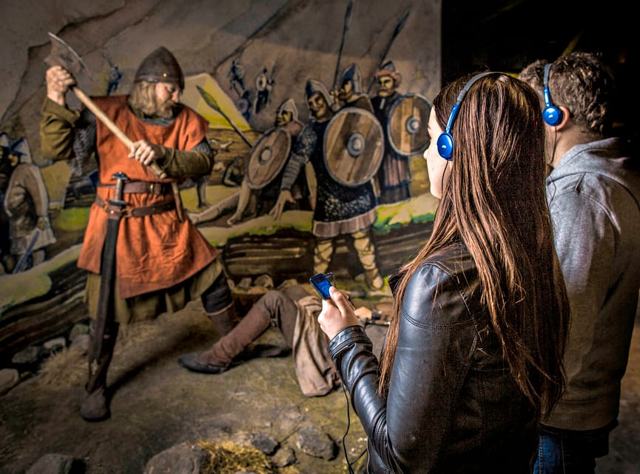
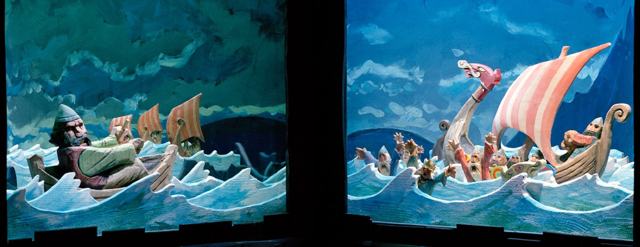
- Saga Museum, Reykjavík. Life-size figures in scenes from Icelandic history, from the first settlers onward. A quick, visual introduction that works well with children. Book Viking Museum Reykjavík tickets with us.
- Viking World (Víkingaheimar), Reykjanesbær. Home of Íslendingur, a full-size copy of a Viking ship that sailed from Iceland to New York in 2000. It is about 10 minutes from Keflavík airport and open all year, which makes it handy on your first or last day.
- The Settlement Centre, Borgarnes. Two exhibitions with audio guides in 15 languages: one on the settlement and one on Egil's saga, the story of a Viking poet and warrior from this area. Open all year, 10:00 to 21:00, in Borgarnes, about an hour north of Reykjavík. Tickets: Settlement & Egils Saga Exhibition.
- Eiríksstaðir, West Iceland. A rebuilt longhouse on the farm of Erik the Red, founder of the Norse colony in Greenland and father of Leif Erikson, who reached North America around 1000. Open 1 April to 31 October. Tickets: Eiríksstaðir Viking Longhouse.
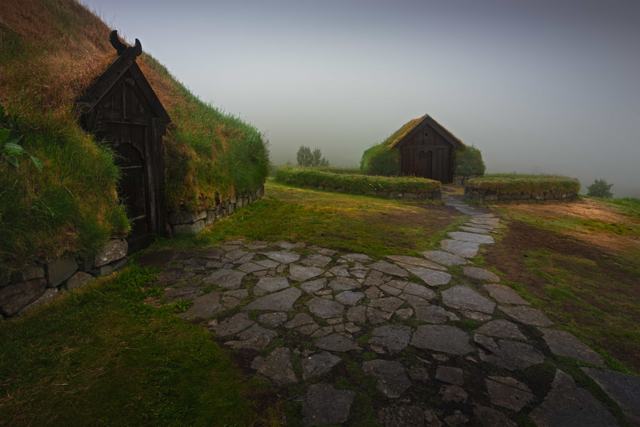
- Þjóðveldisbærinn, Þjórsárdalur. A reconstructed Commonwealth-era farmhouse based on the excavated farm at Stöng, which was buried by an eruption of Hekla.
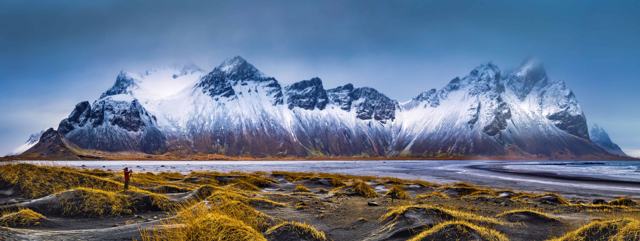
- The Viking Village, Stokksnes. A film set built around 2009–2010 below Vestrahorn near Höfn. It is not historical, but the setting is dramatic. You buy entry at the café at the start of the Stokksnes road, and the fee also covers the beach and Vestrahorn area. You cannot go inside the houses.
Viking activities, festivals and experiences
The Viking Festival in Hafnarfjörður, just south of Reykjavík, is the oldest and largest event of its kind in Iceland. It is held each June around the national day on 17 June and runs for about five or six days. Víðistaðatún park fills with tents and a Viking market, with mock battles, archery, crafts, storytelling and lamb roasting over fires. Traders sell leather goods, furs, silver jewellery, weapons and drinking horns.
The festival is run by Rimmugýgur, Iceland's largest Viking re-enactment group, founded in 1997 and named after a battle axe in Njáls saga. Its members stage the fights, teach visitors archery and explain how the Vikings really lived, dressed and worked. Check exact dates before you plan around it.
In Hafnarfjörður you can also eat at a Viking-themed restaurant and stay in a Viking-themed hotel near the harbour, both open all year. The staff dress as Vikings, the rooms are decorated in the same style inside and out, and there are themed feasts and entertainment on some evenings.
If you want the landscapes of the sagas as well as the stories, look at our West Iceland tours. The west is saga country, from Borgarnes to the Dalir district around Eiríksstaðir. For a quick taste of Viking history on a short break, a Reykjavík tour or a stopover in Iceland is enough time for the Settlement Exhibition and the National Museum. Our Reykjavík walking tour also mixes city sights with stories of Icelandic history and mythology.
Viking heritage in Iceland today
Icelandic has changed less than any other Nordic language, so Icelanders can still read the sagas written 800 years ago. Read more in our guide to the Icelandic language.
The Icelandic horse and Icelandic sheep are descendants of the animals the settlers brought over, and no other horses have been imported for about a thousand years. See our guide to the Icelandic horse or try a horseback riding tour.
Traditional foods such as dried fish, fermented shark and smoked lamb come from the same need to store food through long winters. Our guide to Icelandic traditional food explains what to try. Folk belief in hidden people also runs deep, as you can read in elves and trolls in Iceland.
For anyone who likes history or mythology, a couple of these museums and one evening of Viking food or stories fit easily into a trip. The history here is real, and Icelanders also know how to have some fun with it.
Tours to book
If you want to see Viking Iceland for yourself, these are good places to start.
- Golden Circle Private Tour from Reykjavík: time at Þingvellir, where the Alþingi met, with your own guide.
- Eiríksstaðir Viking Longhouse: the rebuilt home of Erik the Red in saga country.
- Viking Museum Reykjavík: an easy first look at Icelandic history, good with children.

Questions people ask
When did the Vikings come to Iceland?
Norse explorers found Iceland around 860, and tradition says the first permanent settler, Ingólfur Arnarson, arrived in 874. Archaeology shows people were building in Reykjavík around 871. Most of the land was settled by 930.
Who was the first Viking in Iceland?
Naddoddur is said to be the first Norseman to reach Iceland, and Garðar Svavarsson the first to spend a winter. Ingólfur Arnarson is counted as the first permanent settler and the founder of Reykjavík.
Are Icelanders descended from Vikings?
Largely, yes. About 75% of Icelanders' male-line ancestry is Scandinavian, but about 62% of their female-line ancestry comes from Scotland and Ireland, so the population is a Norse and Gaelic mix.
Where can I see Viking history in Reykjavík?
Start with the Settlement Exhibition at Aðalstræti, then the National Museum of Iceland and the Saga Museum. Viking World in Reykjanesbær is close to the airport.
When is the Viking Festival in Iceland?
The Viking Festival in Hafnarfjörður is held every June around 17 June and lasts about five or six days. Confirm the exact dates for your year before you travel.
Who named Iceland?
According to the Book of Settlements, Flóki Vilgerðarson, known as Raven-Flóki. After a hard winter in the Westfjords he climbed a mountain, saw a fjord full of drift ice and called the country Ísland. Earlier visitors had called it Snæland and Garðarshólmur.
Which gods did the Vikings in Iceland worship?
The Norse gods, above all Thor, Odin and Freyr, along with Frigg, Freyja, Baldur, Heimdall and the trickster Loki. Iceland adopted Christianity around the year 1000.
Were the Vikings in Iceland raiders?
Not in Iceland. The settlers came as farmers and fishers, bringing families, slaves and livestock, and claimed land that was almost empty.