The extended Golden Circle, sometimes called the Hidden Circle, takes the classic loop of Þingvellir, Geysir and Gullfoss and carries on into the quieter Þjórsárdalur valley. Along the way you add a natural hot spring at Flúðir, two waterfalls, a reconstructed Viking-age farm and a green gorge. It makes a long but rewarding day, best done in summer, when the gravel roads in the valley are easiest.
What is the extended Golden Circle?
The classic Golden Circle is Iceland's best-known day trip from Reykjavík. It links three sights: Þingvellir National Park, the Geysir geothermal area and Gullfoss.
The extended version keeps those three and adds four or five more stops to the south-east: the Secret Lagoon at Flúðir, Hjálparfoss, the Commonwealth Farm and ruins at Stöng, the gorge Gjáin and Háifoss. The last four sit in Þjórsárdalur, a valley on the edge of the highlands near the volcano Hekla that most Golden Circle visitors never see.
That brings the count from three stops to seven, or eight with Háifoss. The Secret Lagoon is a small detour on the way south from Gullfoss. The valley stops then follow one after another along Road 32, so you are not zigzagging across the countryside. If you want even more ideas near the classic loop, see our post on secret locations of the Golden Circle.
The Hidden Circle route at a glance
Starting from Reykjavík, the stops come in this order. Drive times are rough guides for summer conditions.
- Reykjavík to Þingvellir: about 50 minutes on Road 36.
- Þingvellir to Geysir: about an hour, by Laugarvatn on Roads 365 and 37.
- Geysir to Gullfoss: 10 minutes on Road 35.
- Gullfoss to the Secret Lagoon at Flúðir: about 35 minutes on Road 30.
- Flúðir to Hjálparfoss: about 45 minutes, south on Road 30 and then east on Road 32.
- Hjálparfoss to the Commonwealth Farm: a few minutes further along Road 32.
- On to Stöng and Gjáin: gravel Road 327, about 40 minutes with the walk.
- Háifoss (optional): gravel Road 332, the roughest road of the day.
- Back to Reykjavík: about 125 kilometres and two hours on Roads 32, 30 and 1.
Stop 1: Þingvellir National Park
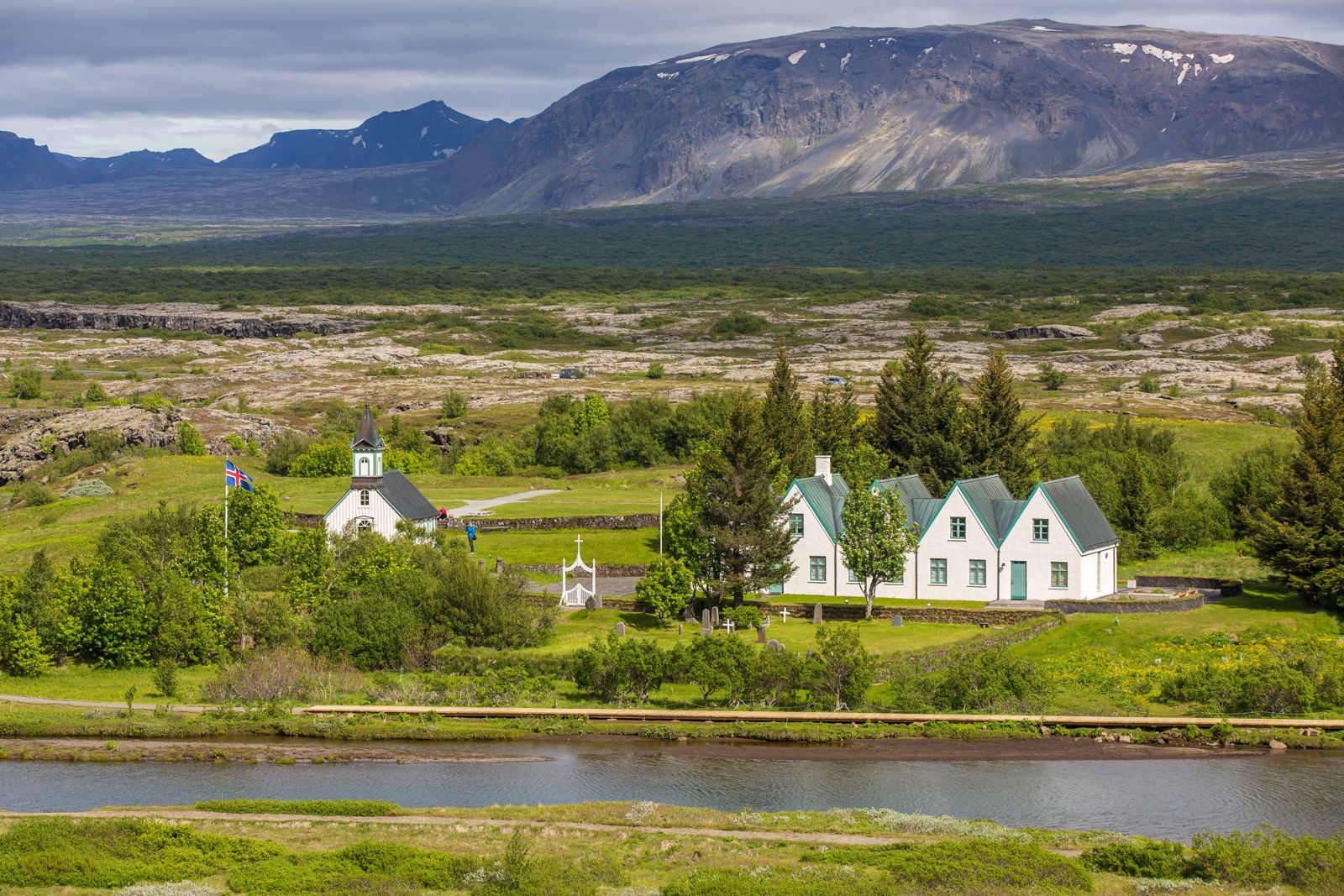
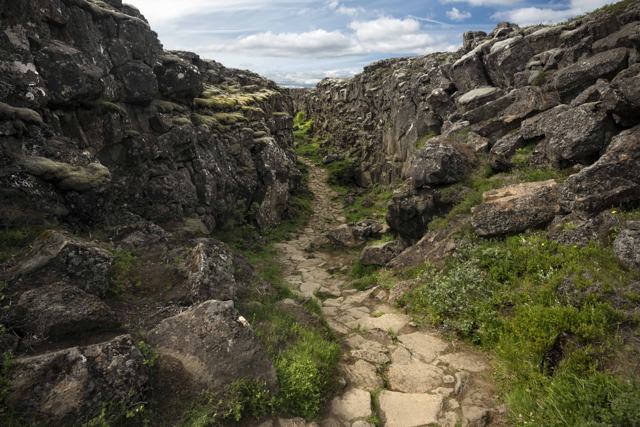
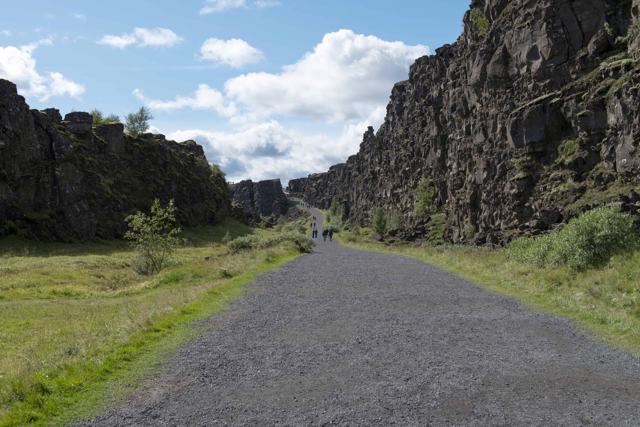
Þingvellir is usually the first stop from Reykjavík, about 50 minutes' drive on Road 36. It is one of Iceland's three national parks and a UNESCO World Heritage Site. Iceland lies across the boundary between the North American and Eurasian tectonic plates, and Þingvellir sits in the rift valley where they pull apart. It is one of the few places in the world where you can see this happening on dry land. Walk down the Almannagjá gorge and follow the path to Öxarárfoss.
This is also where Iceland's parliament, the Alþingi, met from 930. There was never a parliament building here. The assembly gathered in the open air each summer around Lögberg, the Law Rock. Laws were recited, disputes were settled and sentences were passed. In the year 1000 the assembly agreed that Iceland would become Christian. In later centuries Þingvellir was also a place of punishment. People were executed here, some by drowning in the pool Drekkingarhylur, and some were burned in the witchcraft cases of the 17th century.
The park is large, with lava fields, fissures, rivers and the lake Þingvallavatn, and you could easily spend a whole day here. On this route, allow one to two hours.
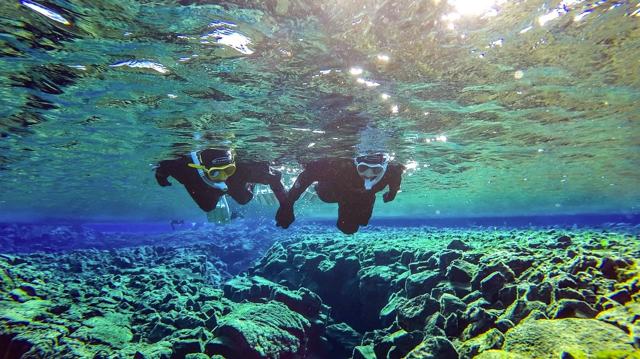
Inside the park is Silfra, a water-filled fissure that opened as the two plates drifted apart. It is Iceland's best-known place to snorkel or dive. The glacier water stays at about 2–4°C all year, so trips run in every season. You need to book this with a licensed guide; see our snorkelling and diving tours or book a private Silfra snorkelling tour.
Parking at Þingvellir costs 1,000 ISK per car for the day. You pay at the machines or online, and one payment covers all the park's main car parks.
Stop 2: Geysir geothermal area
Geysir is the next big stop, about an hour's drive from Þingvellir. The road passes the village of Laugarvatn, where a lakeside spa uses the local hot water. As you come into the Haukadalur valley you see steam rising from the ground well before you arrive.
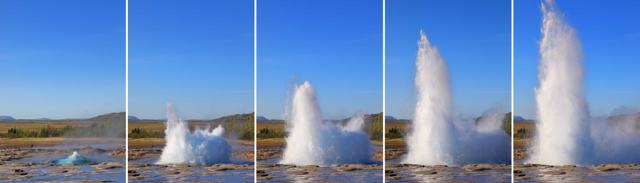
The area is a field of hot pools, bubbling mud pots, steam vents and geysers. The Great Geysir gave its name to geysers everywhere. It was first mentioned in writing in 1647, and in its active years it threw water up to about 60 metres. A height of 170 metres was reported in 1845.
Geysir has gone quiet several times. In 1935 a channel was dug through the silica rim to lower the water level, which woke it up for a while until the channel clogged again. From 1981 eruptions were sometimes set off with soap on special occasions, but this was largely stopped in the 1990s for environmental reasons. Earthquakes in 2000 brought it back to life for a short time, with eruptions reported at 122 metres over two days. Today it erupts only very rarely.
Its neighbour Strokkur is the reliable one. It goes off every 6 to 10 minutes, usually to 15–20 metres and sometimes much higher, so you will see several eruptions even on a short visit.
Stay behind the ropes. The water in the pools is close to boiling, and the ground around them is thin in places. Across the road there is a hotel, a restaurant and café, and a large shop with Icelandic design, woollens and souvenirs.
Stop 3: Gullfoss waterfall
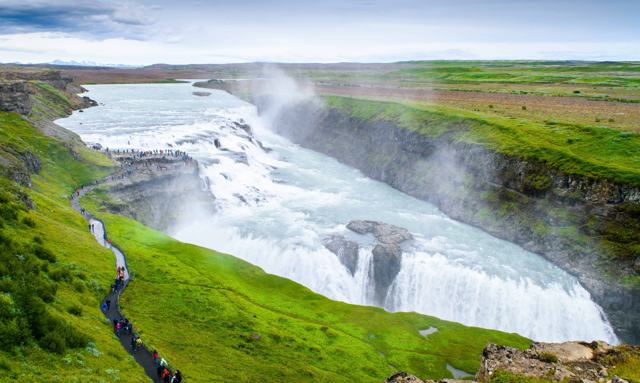
Gullfoss, the Golden Falls, is ten minutes beyond Geysir. The Hvítá river drops in two steps, of 11 and 21 metres, into a gorge about 2.5 kilometres long. In summer an average of around 140 cubic metres of water per second pours over it, roughly half that in winter. What surprises most people is how wide the falls are, and how the river seems to vanish into the earth when you first walk up.
There are two viewpoints: the upper one by the café and the lower path that takes you close to the falls. The spray often hides the bottom of the gorge and makes rainbows on sunny days, so wear a waterproof jacket. The lower path can close in winter because of ice.
In summer the canyon walls are green with moss and grass. In winter the falls keep flowing, but snow and ice build up on the dark rock around them, and on a clear day you can see the Langjökull glacier on the horizon.
Gullfoss also has a well-known story. In the early 20th century the owners, among them the farmer Tómas Tómasson, leased the falls to foreign investors who wanted to build a hydroelectric dam. His daughter, Sigríður Tómasdóttir, fought the plan. She is said to have walked to Reykjavík more than once and to have threatened to throw herself into the falls. Her lawyer was Sveinn Björnsson, who later became Iceland's first president. In the end the project fell through, partly for lack of money. The falls were later sold to the state and have been protected since 1979. A stone memorial to Sigríður stands above the falls.
Stop 4: Secret Lagoon at Flúðir
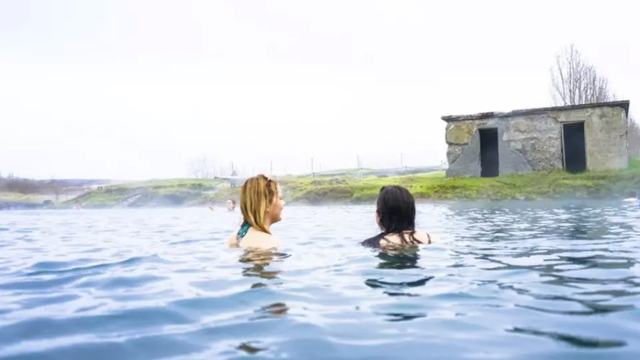
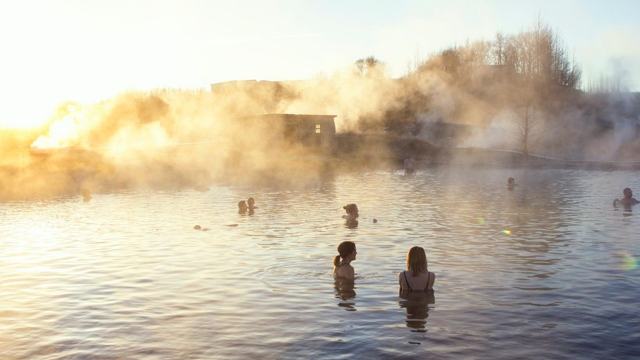
From Gullfoss, drive south to the village of Flúðir and the Secret Lagoon (Gamla laugin). It dates from 1891 and is the oldest swimming pool in Iceland. The pool is fed by hot springs and stays at 38–40°C all year, with a small geyser bubbling beside it.
People often compare it with the Blue Lagoon. The water here is clear and natural, not milky blue, the setting is plain countryside with steam rising from the springs, and it is usually far less crowded. The pool fell out of use in the mid-20th century and reopened in 2014 after a renovation.
It is open daily from 10:00 to 20:00 in summer (June to September) and 10:00 to 19:00 in winter. Adult tickets cost 4,500 ISK and seniors 3,300 ISK, and children 14 and under pay a reduced price. Check the lagoon's website for current prices. It is simpler than the big spas, with changing rooms, showers and a small bistro. Book ahead in busy months.
See our Secret Lagoon tours, such as the Golden Circle & Secret Lagoon Tour, or read our guide to hidden hot springs in Iceland.
Stop 5: Hjálparfoss
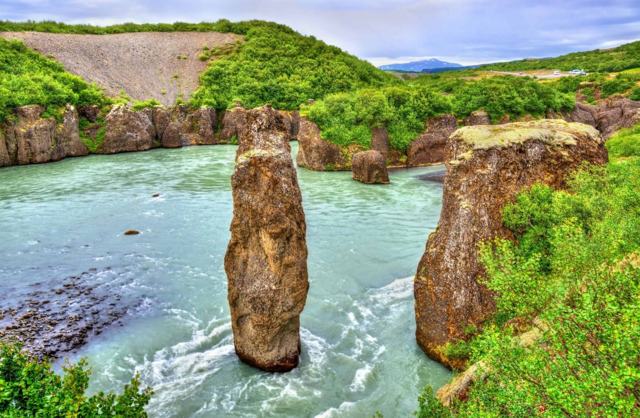
Hjálparfoss sits just off Road 32 in Þjórsárdalur, on the river Fossá near where it meets the Þjórsá. It is the first of the four valley stops. Two streams of water fall side by side into a wide, round pool, framed by curved basalt columns. A large dark rock divides the two falls, and some people see the head of a bear in it.
The name means the helping falls, or Help's Falls. Travellers crossing the barren highlands on the Sprengisandur route came down to grass here, where they could rest and graze their horses. In summer the land above the falls is still green, and on warm days you may see locals taking a dip in the pool. It is cold river water, not a hot spring. In winter the area is under snow and parts of the falls freeze.
The short side road is paved and fine for an ordinary car, and the viewpoint is a few steps from the car park.
Stop 6: Stöng and the Commonwealth Farm
Þjórsárdalur was farmed in the Viking Age. In 1104 Hekla erupted for the first time since the settlement of Iceland and buried the valley's farms, around twenty of them, under pumice and ash. Stöng was one of those farms. Archaeologists excavated it in 1939, and it turned out to be the best preserved. Its ruins lie deep in the valley, under a protective roof.
Down by the main road near the Búrfell power station stands Þjóðveldisbærinn, the Commonwealth Farm, also called the Saga-Age farm. It is a full-size turf longhouse rebuilt from what was found at Stöng, with a small turf-clad church beside it. Inside you can see how a wealthy farming household lived, slept and cooked. The finds from the dig are kept by the National Museum of Iceland.
The Commonwealth Farm is open daily from 1 May to 15 October, 10:00 to 17:30. Entry is 2,500 ISK for adults, 500 ISK for children aged 6–12 and free for younger children. It is a good stop for families and anyone curious about how people lived here a thousand years ago. Our Vikings in Iceland guide has more history.
Stop 7: Gjáin
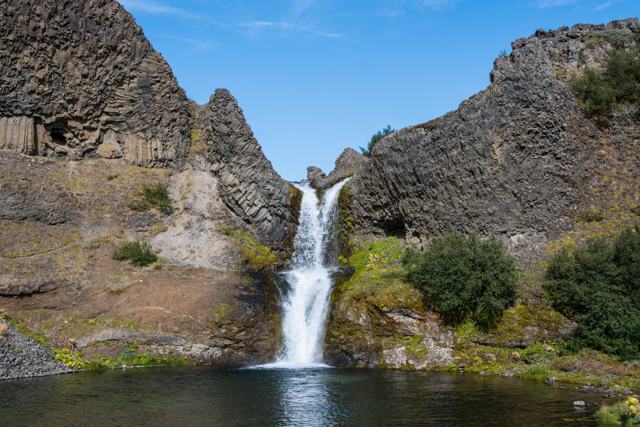
About a kilometre's walk from the Stöng ruins is Gjáin, a small green gorge on the river Rauðá. It has little waterfalls, clear pools, moss, basalt columns, small lava caves and other lava formations. People call it an oasis because it appears without warning in the grey pumice sands. Allow about 40 minutes to get here from the Commonwealth Farm, counting the drive and the walk.
Gjáin is at its best in summer, when the vegetation is green and the sun is out. In winter snow covers most of the colour. Locals have long said that elves and hidden people live in places like this, and on a quiet summer evening it is easy to see why. Gjáin was also used as a Game of Thrones filming location; see our Game of Thrones locations guide.
The road in, Road 327, is gravel and can be bumpy after rain. You can park near Stöng and walk, or park above the gorge and walk down. The vegetation is fragile, so stay on the paths and do not swim in the pools.
Stop 8 (optional): Háifoss and Granni
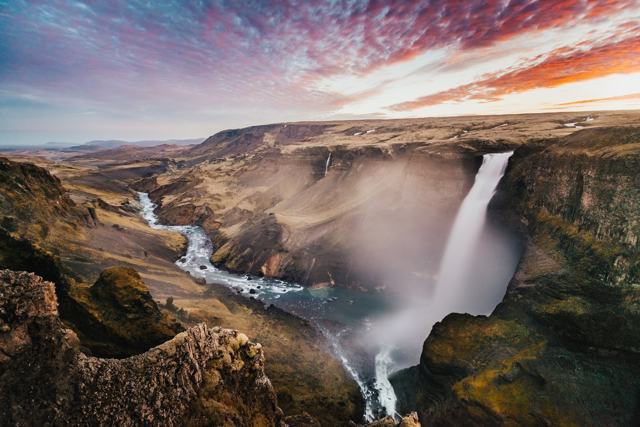
If you have time and the right car, finish at Háifoss. At 122 metres it is one of Iceland's highest waterfalls, and for a long time it was thought to be the highest. It is fed by the Fossá, the same river that forms Hjálparfoss lower down. Just before the cliff the river splits in two. One branch becomes Háifoss, the high falls, and the other becomes Granni, the neighbour.
From the viewpoint on the canyon rim you look across at both: Háifoss on your left and Granni on your right. The canyon walls are dark rock streaked with moss, and on sunny days rainbows form in the spray. There are no railings, so keep back from the edge, especially in wind.
It is possible to hike down into the gorge on a steep, loose path. Only try it in dry weather, with proper boots and plenty of time.
The last part of the drive is about 7 kilometres on Road 332, a rough, potholed gravel road. A 4×4 or a small SUV with good clearance is strongly advised, and it is not maintained in winter. The main viewpoint is a short walk from the car park. Keen hikers can also walk up along the Fossá from Stöng, a trip of several hours.
How long does the extended Golden Circle take?
Plan a full day. The classic Golden Circle alone is roughly 230–250 kilometres and 6–8 hours with stops. Adding Flúðir and Þjórsárdalur makes a long loop, and you should allow 10–12 hours if you visit every stop and have a swim. The drive back to Reykjavík from Þjórsárdalur is about 125 kilometres, or two hours, on Roads 32, 30 and 1.
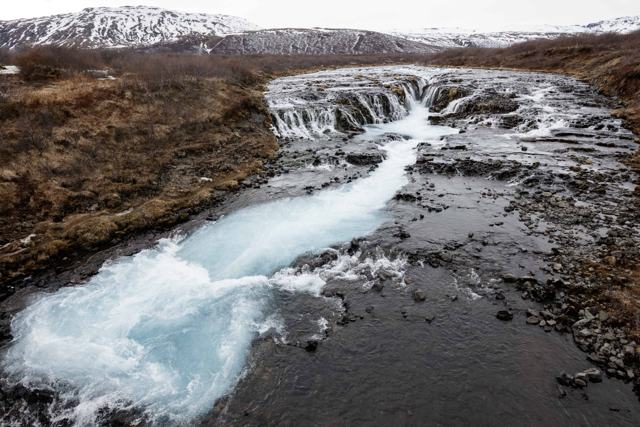
If that feels like too much, split it. Do the classic three on one day and Þjórsárdalur on another, or stay a night near Flúðir or Selfoss. Other good additions nearby include Kerið crater, Brúarfoss, Faxi and Friðheimar tomato farm. Our post on secret locations of the Golden Circle has more ideas.
When to go and what car you need
The classic Golden Circle is open all year on paved roads. Þjórsárdalur is best from late May to September. In winter the gravel roads to Gjáin and Háifoss are not maintained, and the Commonwealth Farm is closed from mid-October to the end of April. Check road.is and vedur.is on the morning you drive.
An ordinary car will reach Þingvellir, Geysir, Gullfoss, Flúðir and Hjálparfoss in summer. For Gjáin and especially Háifoss, rent a 4×4. Rental insurance often does not cover damage from rough gravel roads, so read the terms.
Big changes are planned for the valley. A new development in Þjórsárdalur plans cabins and a welcome house with a restaurant from summer 2027, and geothermal baths and a hotel from 2028, though dates like these can slip.
Guided tours or self-drive
Self-driving gives you the most freedom and is the easiest way to see every stop in one day. If you would rather not drive gravel roads, a guided tour takes care of it. Many Golden Circle tours from Reykjavík include the Secret Lagoon, and super jeep tours and private tours can reach Þjórsárdalur and Háifoss. Our Golden Circle Private Tour from Reykjavík covers Þingvellir, Geysir and Gullfoss at your own pace. You can also combine the loop with a South Coast tour on a 2-day trip or the 3 Day Golden Circle & South Coast Tour.
Planning a road trip instead? Browse our self-drive packages.
- Golden Circle Private Tour from Reykjavík: your own local guide for the classic three, at your own pace.
- Golden Circle & Secret Lagoon Tour: the classic loop with the swim at Flúðir included.
- 3 Day Golden Circle & South Coast Tour in Iceland: more time for the Golden Circle, plus the South Coast.

Questions people ask
What is the Hidden Circle in Iceland?
It is an extended version of the Golden Circle. It adds the Secret Lagoon at Flúðir and the Þjórsárdalur valley, with Hjálparfoss, the Commonwealth Farm and Stöng, Gjáin and Háifoss, to Þingvellir, Geysir and Gullfoss.
How long does the extended Golden Circle take?
Allow a full day of 10–12 hours if you visit every stop and swim at the Secret Lagoon. Many people split it over two days.
Do I need a 4×4 for the extended Golden Circle?
Not for the classic stops, the Secret Lagoon or Hjálparfoss in summer. For Gjáin and especially Háifoss on Road 332, a 4×4 or SUV with good clearance is strongly advised.
Can I do the extended Golden Circle in winter?
Partly. Þingvellir, Geysir, Gullfoss, the Secret Lagoon and usually Hjálparfoss can be visited, but the gravel roads to Gjáin and Háifoss are not maintained and the Commonwealth Farm is closed from mid-October to April.
How much does the Secret Lagoon cost?
Adult tickets are 4,500 ISK and seniors 3,300 ISK, and children 14 and under pay a reduced price. Check the lagoon's website for current prices. Booking ahead is recommended.
Does the Great Geysir still erupt?
Only very rarely. It was briefly active after earthquakes in 2000. The geyser you will see erupting is Strokkur, right beside it, which goes off every 6 to 10 minutes.
Who saved Gullfoss from being dammed?
Sigríður Tómasdóttir, the daughter of one of the owners, is credited with it. She campaigned against a plan by foreign investors to build a hydroelectric dam in the early 20th century. The project fell through, and the falls have been protected since 1979.
What happened to the farm at Stöng?
Stöng was buried by pumice and ash when Hekla erupted in 1104. The ruins were excavated in 1939, and the Commonwealth Farm (Þjóðveldisbærinn) nearby is a full-size reconstruction.