Iceland Travel GuideLOCAL TRAVEL AGENCY IN ICELAND
My trip
Talk to a local
Iceland Travel GuideLOCAL TRAVEL AGENCY IN ICELAND
My trip
Talk to a local
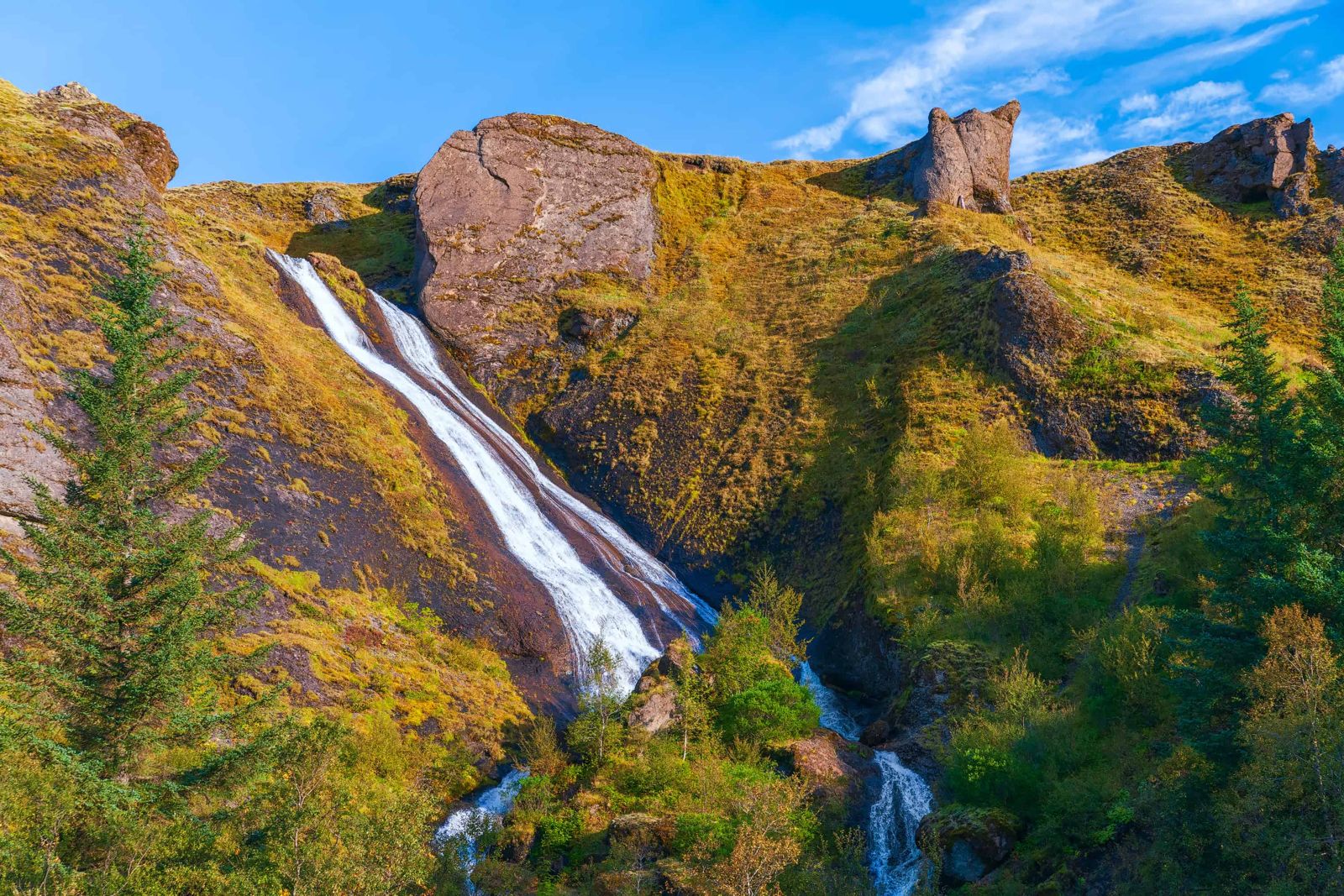
Systrafoss (“Sisters’ Falls”) is a waterfall with two streams on a cliff right above the village of Kirkjubæjarklaustur on Iceland’s South Coast. It is free, open all year, and you can park beside it. A walk to the top and the lake Systravatn takes about an hour. Kirkjubæjarklaustur is around 3 hours 20 minutes by car from Reykjavík.
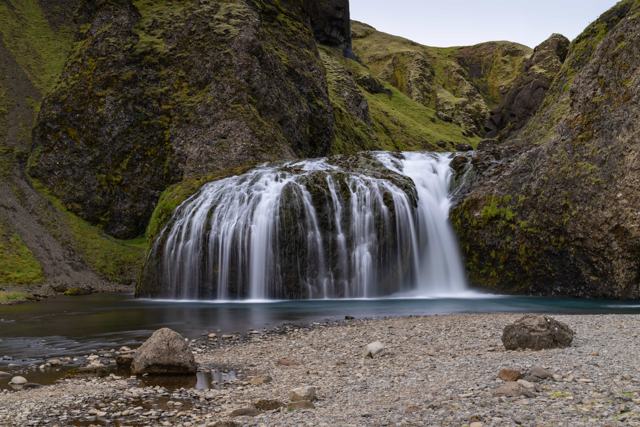
Systrafoss is fed by the river Fossá, which flows out of the lake Systravatn on the plateau above and spills over the cliff edge in two streams side by side. The waterfall is visible from the road and the car park at the foot of the hill, so you can look at it in a minute or take the walk up.
A path with steps leads up beside the falls to the top. From above you get a view over the village, the flat plains and the Skaftá river to the south. There is a small forest, planted in the 1940s, at the foot of the waterfall, with a circular path through it. The village has a long history, and the waterfall is tied into it through the legend of the nuns.
Locals shorten Kirkjubæjarklaustur to Klaustur. If you want to try the full name, it is said roughly “KIR-kyu-bye-yar-KLOY-stur”. The village grew up around a convent, and many place names still point back to the nuns: Systrafoss, the lake Systravatn above it and the rock Systrastapi just to the west.
A Benedictine convent stood at Kirkjubær from 1186 until the Reformation in the 1550s, and the name Systrafoss refers to the nuns, “the sisters”. Local legend says the nuns bathed in the lake Systravatn above the falls. In one story, a hand holding a golden comb rose from the water. The nuns who tried to grab it were drowned.
Another legend is about Systrastapi, a flat-topped rock just west of the village. Two nuns who broke their vows are said to have been burned at the stake and buried on top of it. One was accused of selling her soul to the Devil, the other of speaking ill of the Pope. After the Reformation the second nun was seen as innocent, and the story goes that flowers grow only on her grave.
In the village itself, look for the sculpture Byrði sögunnar, “the burden of history”, which stands as a reminder of this long past.
The Ring Road is paved and open all year, but it can be icy and windy in winter. Check umferdin.is and vedur.is before you drive.
The waterfall is at the start of a few easy walks above the village.
Take care near the edge at the top, and stay on the path in wet weather.
There is a car park next to the waterfall. Toilets, a fuel station, a shop, cafés and a swimming pool are in Kirkjubæjarklaustur village.
Kirkjubæjarklaustur has a hotel, guesthouses, cottages and a campsite, and there are farm stays nearby. It is a good overnight stop on the Ring Road.
Yes. There is no entrance fee, and it is open all year.
In Kirkjubæjarklaustur on the South Coast, next to the Ring Road, about 3 hours 20 minutes by car from Reykjavík.
Yes. A path with steps leads up beside the falls to the lake Systravatn. It can be slippery in winter.
“Sisters’ Falls”, after the nuns of the old Kirkjubær convent.
Yes, there is a car park next to the waterfall.
It falls in two streams side by side, of about the same height, so it looks like twin waterfalls coming down the hill.
Roughly “KIR-kyu-bye-yar-KLOY-stur”. Most people just say Klaustur.